
Forest of a Thousand Bars: Guru & Surrender
Making peace with the practices and the Guru!

How a Guru Uses Your Obstacles to Grow Your Surrender
Picture a seeker in a forest. Red-blue dhoti. Bare feet on dust. A huge tree behind him. In front: a long track filled with hurdles—hundreds of them—yet he can’t see a single one. That is most of us on the path. Our obstacles are ours, but they are invisible to us. They are Agyan/Avidya—conditioning, habits, fears, identities—so close to our face that we call them “me.”
On the side stands the Guru. Calm. Smiling. She can see every hurdle on your track. She also knows which one you must meet now. That “now” matters. Right obstacle, right time, right depth. That is guidance.
What a Guru Really Does
A Guru does not decorate your life. A Guru dismantles what blocks your life. She sees the knots you tied—this life and others. She knows which string can be pulled today without tearing you apart. So she prescribes a specific sādhana (practice) or tapasya (austerity).
Sometimes it is mantra, sometimes silence.
Sometimes service, sometimes retreat.
Sometimes a conversation you’ve avoided, sometimes a fast you don’t want.
You practice. And then, suddenly, you see a hurdle you never knew existed: jealousy so old it felt like spine, pride that dressed up as “standards,” a wound that kept you superior and alone, tenderness you refused to show because it made you human. With the Guru’s presence and your own effort, you climb. Knowledge of that limitation happens. A little Knowledge of the Infinite peeks through. The ego dies another small death. A mask falls. And samarpan—surrender—arises by itself.
That cycle is the work. The Guru repeats it with every seeker who is willing.
Why You Don’t Pick Your Own Hurdles
We love to choose practices that fit our taste. We want the “advanced” meditation, the rare initiation, the dramatic vision. But the Guru may say no. Why? Because that choice could inflate a new identity—“the one who knows,” “the one who suffered,” “the special devotee/knower.” The point is not to add spiritual muscle to the same old ego. The point is to dissolve what blocks Infinite.
Samarpan cannot be taught. The Guru sets you in the current of practices until your strokes fall away and you are held by what holds all.
DIY spirituality often creates the neatest cages. The Guru prevents that. She ensures that your sādhana and your knowledge do not breed more ego.

First Surrender: To the Practice Itself
We speak of surrender to God, to Truth, to the Guru. Before that, there is a simpler surrender: obey your practice. Keep the watch. Do the repetitions. Show up when it is dull. Report honestly. This is how the invisible hurdles become visible. Surrender to sādhana is surrender in seed form.
How Hurdles Reveal Themselves
Here is a simple map:
Instruction given. You agree.
Friction begins. Boredom, resistance, excuses, “urgent” distractions.
The hidden hurdle surfaces. You notice a pattern you could not see before.
Stay with it. Don’t run. Don’t explain. Don’t decorate it with theory.
Cross with help. Use the tool given—breath, mantra, apology, service, silence.
Insight dawns. “Ah, this is what has been ruling me.”
Softening. Ego loses one more foothold. A small, clean joy appears.
Report. Receive next step. Continue.
Repeat. Gentle. Relentless.
Signs You Are Building Ego Instead of Surrender
You need to announce your practice or your visions.
You compare: “My path is deeper than theirs.”
Your practice makes you more separate, not more available.
You ask for particular practice, without knowing "what" you will cross.
You tell (not ask) your Guru that you are meant for Bhakti and not Kriya, you need more Gyan, more words to have Bhakti, or something on these lines.
You collect methods but rarely finish any.
Criticism breaks you or hardens you, makes you run-away, change Guru, but never humbles you.
If you spot these, pause. Ask your Guru for a small, concrete practice that cuts vanity, not feeds it. Seva (selfless service), keeping promises, cleaning your speech—these are sharp knives.
Working With What You Can’t See
Obstacles are mirrors. Use them. When a trigger bites, ask:
What is it asking me to defend?
What story would collapse if I don’t defend it?
What simple act would free me right now? (Apologise, stay, leave, be quiet, speak truth.)
Keep a brief journal. Not for literature. For pattern-tracking. The goal is not self-analysis; the goal is self-honesty.
Effort and Grace
Your effort is the boat. Grace is the river. Rowing matters; current matters more. You cannot force surrender; you can make surrender inevitable by showing up where Grace meets effort—on the practice mat, in the apology, in the honest report to your Guru.
“Do the small true thing. Let the vast true thing do you.”
A Short Field Manual for Seekers
Consent daily. Every morning: “Guruji, I agree to today’s hurdle.”
Small faithful acts over big heroic plans. Consistency outscores intensity initially.
Report fast. Don’t let shame stall the process. Truth thrives in light.
Guard humility. Laugh at yourself every day. It dissolves crust.
Don’t shop for practices. One knife used well cuts deeper than a drawer of blades.
Rest cleanly. Sleep, simple food, a little silence. A dull blade can’t cut.
Serve someone who cannot repay you. Ego hates that; Infinite loves it.
When overwhelmed, simplify to breath. Inhale “Yes.” Exhale “Let go.” Ten rounds. Then act.
What Progress Really Looks Like
It is not fireworks. It is less delay between seeing and choosing the true thing. It is less inner argument before you bow. It is the ability to be corrected without shrinking or performing. It is ordinary joy for no reason. It is the quiet birth of trust—in the path, in the Guru, in the deeper Self that is not threatened by loss.
The Image, Revisited
Return to the forest. The hurdles are still there. You still cannot see them all. Good. You don’t need to. That is the Guru’s job. Your job is simpler:
Stand where you are asked to stand.
Do what you are asked to do.
Tell the truth about what happens.
Take the next step.
One hurdle at a time. One honest crossing at a time. Each crossing loosens an identity you once mistook for “me.” Each loosening lets samarpan rise on its own. This is how a seeker becomes a lover of Truth.
You may not notice the change, but others will. The eyes soften. The speech simplifies. The need to be right weakens. Among people you choose Silence. Gratitude shows up for small things—the way light falls on the floor, the taste of water after practice, the fact that you are guided at all.
In the end, the forest is not a maze; it is a training ground. The hurdles were never enemies; they were tailored lessons. And the smiling Guru at the side was not controlling your fate; she was protecting your surrender.
Walk on. When you stumble, fall into practice, not into drama. When you feel strong, choose the quiet good over the showy good. When in doubt, ask for the next small hurdle, not the final prize.
One day you will turn back and see a long path of fallen bars behind you. You will realize that the One who crossed, the One who guided, and the field itself were never separate. Until then, keep it simple:
Show up. Cross what is in front of you. Let samarpan do the rest.

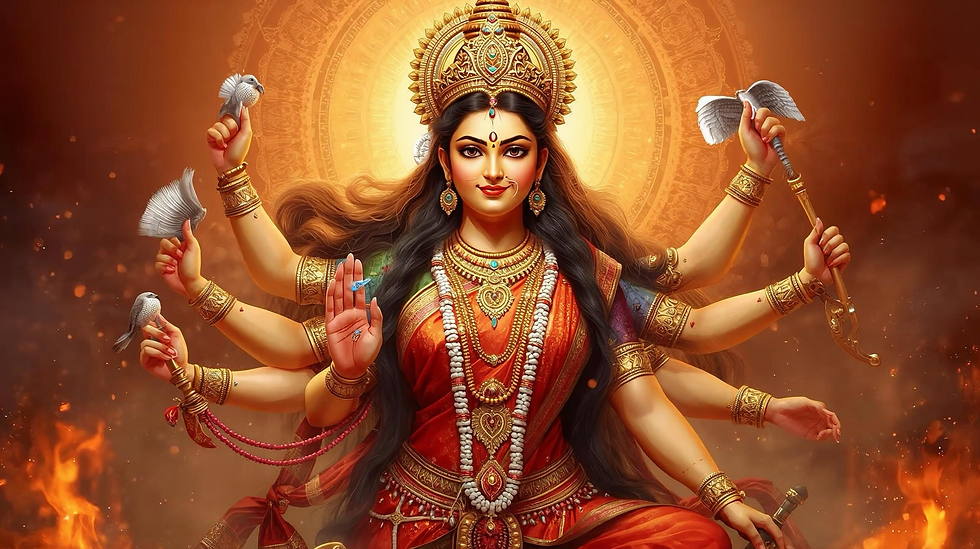
Jai Maa Durga,
~ Prakriti


Comments